
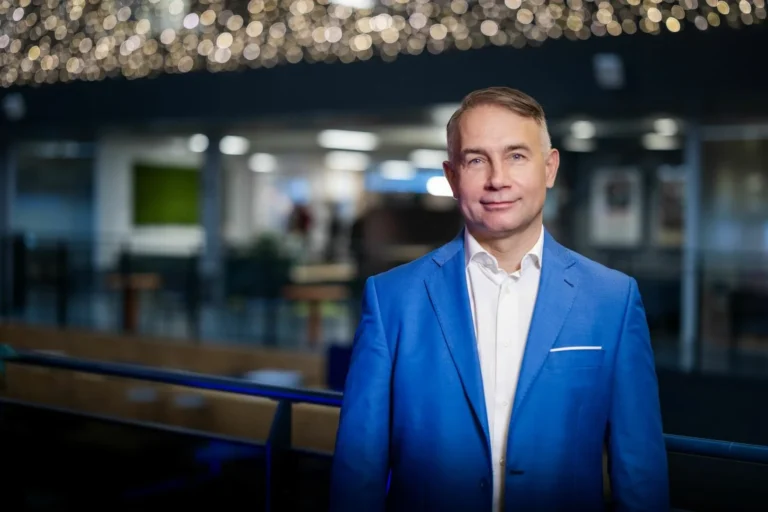
In an era where digital marketing can manufacture instant visibility, a fundamental question remains for the business world: can a well-funded campaign ever truly replace the weight of a personal recommendation? This tension between the ‘attention economy’ and the ‘relationship economy’ was at the heart of a recent discussion between Algirdas Stonys, the founder of TeleSoftas and current head of LTMilTech, and marketing specialist Eglė Pilypaitė.
Stonys, a prominent figure in the Baltic tech ecosystem and a former TEDx speaker, argues that networking is no longer a peripheral activity or a social luxury. Instead, it has evolved into a primary infrastructure for business growth. For the modern leader, success is increasingly dictated not by the product’s price point alone, but by the reputation that precedes them when they are not in the room.
The Architecture of Trust in B2B
The shift from simple marketing to relationship-driven commerce is particularly acute in the B2B sector. Unlike consumer retail, B2B decisions often involve high stakes, long-term commitments, and significant risk. Pilypaitė notes that while marketing is excellent at capturing attention and positioning a brand, it often struggles to bridge the final gap: the creation of a sense of security.
In high-value contracts, the buyer isn’t just purchasing a service; they are purchasing the peace of mind that the provider will deliver. This security is almost always anchored in human reputation. Stonys points out that structured environments—such as the Chambers of Commerce, Industry and Crafts in Vilnius and Kaunas, or international networks like BNI—serve as more than just meeting points. They act as testing grounds for credibility. In these spaces, professional bonds are forged through consistency and mutual accountability rather than temporary promotional spikes.
From ‘Closed Circles’ to Reputation Economies
A common critique of relationship-based business is the risk of it becoming an exclusionary ‘old boys’ club.’ In Lithuania, this is often colloquially referred to as svogerių kraštas (the land of brothers-in-law). However, the discussion elevates this concept, suggesting that the difference between a ‘closed circle’ and a ‘reputation economy’ lies in the maturity of the system.
In mature business ecosystems, connections act as catalysts for trust, lowering the barrier to entry for innovative ideas. In weaker systems, they can become tools for privileged access. The challenge for modern entrepreneurs is to navigate these networks transparently, ensuring that their ‘social capital’ is built on verifiable performance rather than mere proximity to power.
The Philosophy of ‘Hakuna Matata’ Leadership
Beyond the mechanics of networking, Stonys shares a personal philosophy that informs his leadership style—a principle of ‘lightness’ or a disciplined ‘Hakuna Matata’ state. This is not a call for a lack of seriousness, but rather an internal discipline to avoid unnecessary drama and allow processes to flow without the friction of ego.
This calm demeanor is presented as a strategic advantage. A leader who maintains internal stability is more likely to foster stable, clear relationships and generate less ‘noise’ in their professional environment. It is this clarity that often attracts high-level partners and investors who are wary of volatile leadership.
Security, Vision, and the Space Elevator
Stonys’ current focus has shifted toward the defense and security sector through LTMilTech and his involvement in the ‘Defending Baltics’ program. He posits that national security is the baseline for all economic activity; without it, stable investment and business freedom are impossible. This pivot reflects a broader trend among tech leaders who are increasingly aligning their commercial interests with regional stability.
Yet, he remains a visionary, often discussing futuristic concepts like a ‘space elevator.’ While such ideas may seem far-fetched, they serve a specific reputational purpose. They signal a capacity for long-term thinking that extends beyond the next fiscal quarter. In the relationship economy, being a person of vision is often as valuable as being a person of competence, as it inspires the curiosity and trust of those looking to build the future.
Ultimately, the discussion concludes that business rarely begins with institutions; it begins with people. The ‘Friends, Fools, and Family’ model of early-stage funding remains a testament to the fact that the first capital any entrepreneur possesses is their existing web of relationships. Networking, therefore, is not just a tool for growth—it is the very foundation upon which the first brick of any enterprise is laid.
Original reporting by: bns
Source: BNS
Context & actions About this article
Article contextPeople & topics2#5
What do you think about this article?
Reader Ideas Newsroom
Have a sharper angle for this topic? Add it to the community idea board and let readers vote it up for editorial review.



/linkComments
8+ useful words can earn +10-60 DP; shorter replies can still publish without DP.