Labour secures dominant Ealing majority to lead borough services
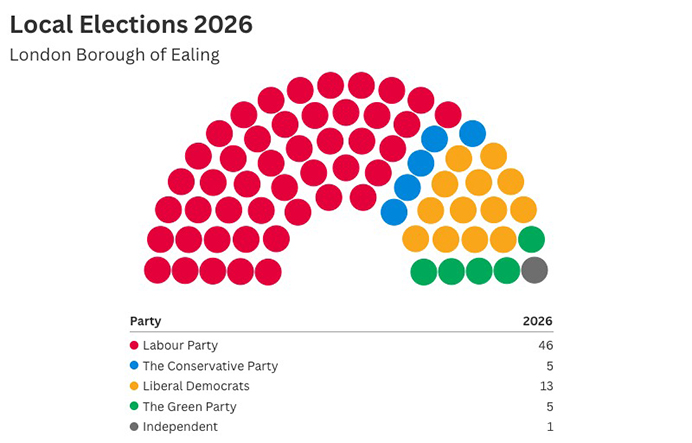
Ealing residents have returned a decisive verdict at the ballot box, granting the Labour Party a significant majority to manage the borough’s essential services for the next four years. With 46 of the 70 available seats now held by Labour, the party possesses the mandate required to steer the local authority’s strategic direction through the end of the decade.
Labour secures 46-seat majority in Ealing Council
The election results, confirmed following the overnight count in central Ealing, establish a clear political hierarchy within the council. The Labour Party’s 46 seats provide an overall majority, effectively centralizing decision-making power for the upcoming term. This dominance allows the administration to implement its long-term vision for the borough without the immediate necessity of cross-party coalitions.
The Liberal Democrats have emerged as the primary opposition, securing 13 seats. The remaining council composition includes five Conservative Party representatives, five Green Party members, and one Independent candidate. This distribution reflects the political landscape across the borough’s 24 wards, though the Labour majority remains the defining factor in how the council will function until 2030.
Direct impact on Ealing municipal services and facilities
The outcome of the vote dictates the management of hundreds of services that affect the daily lives of Ealing’s 250,275 electors. As the governing party, the Labour Party will oversee the administration of adult social care, the maintenance of local parks, and the operation of leisure centres and libraries.
Strategic priorities for bin collections, street cleaning, and the management of council housing are now firmly within the party’s remit. Furthermore, the council’s influence extends to the local education sector, where it manages numerous schools across the borough. The 70 elected councillors—three representing each of the 22 larger wards and two representing each of the remaining two—will act as the primary link between residents and these municipal functions, ensuring that local concerns are integrated into the council’s broader strategies.
Voter turnout and democratic engagement in the borough
Participation in this election saw 43.5% of the electorate cast their votes, a figure that highlights the level of civic engagement in local governance. The count, which took place on Thursday, 7 May, processed ballots from across the entire borough, reflecting the varied political leanings of different neighborhoods.
While the Labour Party holds the majority, the presence of Liberal Democrats, Conservative Party, and Green Party voices ensures that the council chamber will host a spectrum of debate. These representatives are tasked with overseeing the council’s work and making decisions that impact everything from local planning applications to broader environmental strategies. The council reported the progress of the count throughout the evening via its social media channels, maintaining transparency as the new administration took shape.
Strategic priorities for the 2026-2030 council term
Each of the 70 elected individuals now begins a term that lasts for the next four years. Their primary responsibility is to advocate for the specific needs of their ward residents while managing the council’s extensive portfolio of facilities. This involves navigating the complexities of local government to ensure that ward-specific issues—such as road maintenance or community safety—are addressed within the council’s fiscal framework.
The administration will now move to set its formal strategies and priorities for the borough. Residents can view the full results for each specific ward on the Ealing Council website, which provides a detailed breakdown of the 70 candidates elected to office. This data offers a granular look at how different areas of the borough voted and which representatives will be leading local decision-making through 2030.
Source: Ealing Council