Lithuania: 76% Support Referendum on Constitutional Family Definition

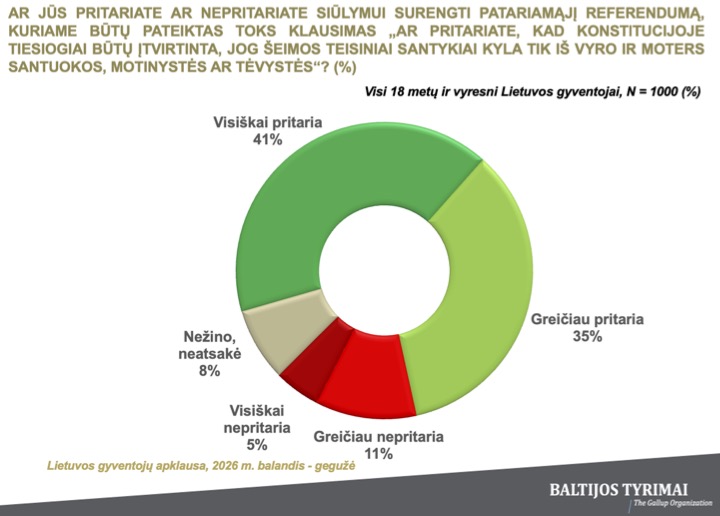
A significant majority of the Lithuanian public is calling for a direct say in how their country defines the concept of ‘family.’ According to a comprehensive survey conducted by the market and public opinion research firm Baltijos Tyrimai, 76% of citizens support the idea of a consultative referendum to decide whether the Constitution should explicitly state that family legal relations arise only from marriage between a man and a woman, as well as motherhood and fatherhood.
The data suggests a rare moment of national consensus in the Baltic state, where social issues often mirror the broader cultural tensions seen across the European Union. Of those surveyed, 41% expressed ‘full support’ for the referendum, while 35% said they were ‘somewhat in favor.’ Only 16% of the population opposed the initiative, with the remaining 8% undecided.
A Unified Public Voice Across Demographics
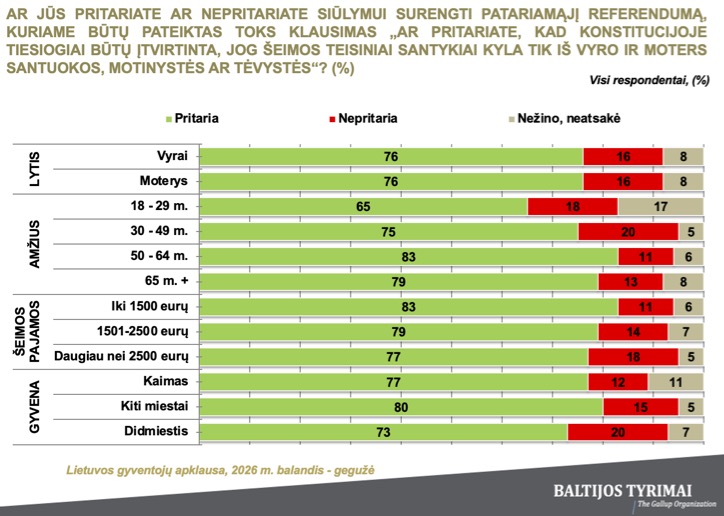
What makes these findings particularly striking is the uniformity of support across nearly every socio-demographic group. Regardless of gender, income, or social status, support for the referendum consistently hovered between 73% and 83%. Even among the younger generation (under 29), who are typically viewed as more socially liberal, 65% supported holding the vote.
Geographically, while support peaked in smaller towns and rural areas, it remained robust in major cities, where nearly three-quarters of respondents backed the initiative. Perhaps most surprisingly, marital status did not diminish the desire for a referendum; 78% of married individuals and 86% of divorcees supported the move. Even among single respondents, support (63%) outweighed opposition (21%) by a factor of three.
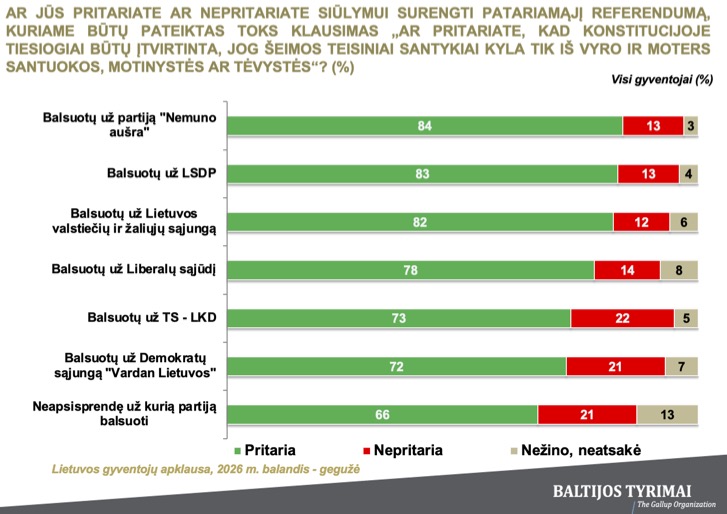
| Political Group / Demographic | Support for Referendum |
|---|---|
| National Average | 76% |
| Nemunas Dawn Supporters | 84% |
| Social Democratic Party Voters | 83% |
| Farmers and Greens Union (LVŽS) | 82% |
| Liberal Movement Supporters | 78% |
| Homeland Union (TS-LKD) Voters | 73% |
| Youth (Under 29) | 65% |
| Divorced Respondents | 86% |
Political Consensus in a Divided Landscape
While the definition of family is often a polarizing topic in parliamentary debates, the survey indicates that voters across the political spectrum are largely in agreement about the need for a public vote. High levels of support were recorded not just among conservative-leaning parties like the Farmers and Greens Union (82%), but also among supporters of the Liberal Movement (78%) and the governing Homeland Union (73%).
This broad alignment suggests that the push for a referendum is viewed by many not necessarily as a partisan maneuver, but as a fundamental question of national identity and democratic participation. For the Lithuanian electorate, the referendum represents a mechanism to provide a clear mandate on a social issue that has seen significant debate within the Seimas (Parliament) in recent years.
The Path to a Consultative Vote
It is important to distinguish between the nature of this proposed vote and binding referendums seen in other jurisdictions. A ‘consultative’ referendum in Lithuania serves as a formal gauge of public will. While it does not automatically rewrite the Constitution, a strong ‘yes’ or ‘no’ vote places immense political pressure on lawmakers to align the legal framework with the expressed desires of the citizenry.
Critics of the initiative often argue that such referendums can be used to marginalize minority rights or bypass the nuanced legislative process. However, the survey results indicate that the Lithuanian public is currently less concerned with these critiques and more focused on establishing a definitive, constitutionally protected definition of the family unit.
As the debate continues in the Seimas, these figures provide a powerful data point for proponents of the referendum. With three-quarters of the country in favor of being asked their opinion, the pressure on the government to facilitate this democratic exercise is likely to intensify as the proposed dates in 2026 approach. The study, which interviewed 1,000 residents across 111 sampling points, carries a margin of error of 3.1%, making it one of the most definitive snapshots of Lithuanian public sentiment on this issue to date.
Source: ELTA