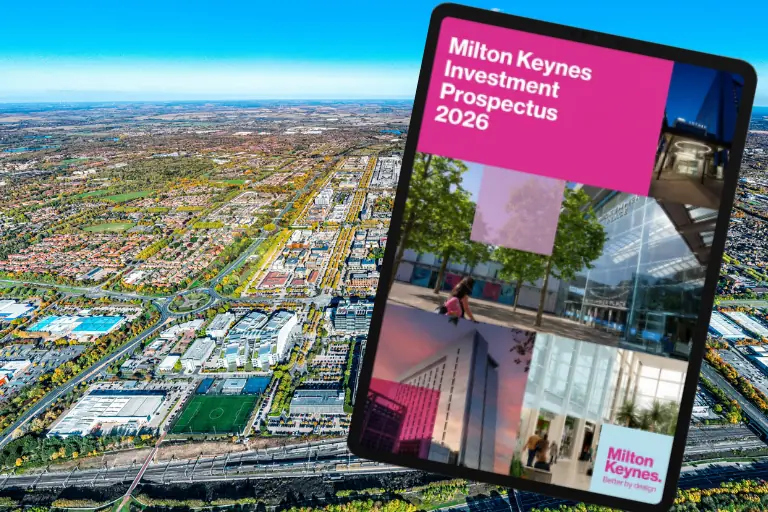
Milton Keynes is using a £1.6bn-plus development opportunity, a £240m city centre scheme and a wider pipeline of housing, transport and employment projects to pitch itself as one of the UK’s strongest investment targets.
The Milton Keynes investment prospectus, launched by Milton Keynes City Council at UKREiiF, frames the city’s next phase around new homes, jobs, infrastructure and commercial space. The figures are large, but they are not automatic delivery guarantees. They show the scale of sites and opportunities being offered to investors, developers and public-sector partners.
The council says Milton Keynes now has more than 300,000 residents, supports over 200,000 jobs and generates more than £16.7bn in gross value added. Productivity is described as around 25% higher than the UK average, a comparison the council is using to strengthen its case to employers and funders.
The numbers behind the investment pitch
| Measure | Figure from the prospectus launch |
|---|---|
| Residents | More than 300,000 |
| Jobs supported | More than 200,000 |
| Economic output | More than £16.7bn GVA |
| Productivity | Around 25% above UK average |
| MK Gateway | £240m mixed-use scheme |
| Lower Westside Block B4 | £1.6bn-plus opportunity |
The economic figures help explain why Milton Keynes is being marketed as more than a commuter city between London and the Midlands. A large jobs base, high productivity and central UK location make the city attractive for offices, logistics, research, education and mixed-use development.
They do not prove that every project will be built quickly, or that growth pressures will be easy to manage. Planning consent, infrastructure funding, market conditions and local support will still shape how fast the pipeline moves from prospectus to construction.
Two development-ready sites lead the pipeline
The prospectus names MK Gateway and Lower Westside Block B4 as two development-ready investment sites.
MK Gateway is described as a £240m mixed-use scheme in Central Milton Keynes, with Grade A offices, Build-to-Rent homes and workspace for small and medium-sized businesses. That places it in the part of the city where rail access, office demand and regeneration plans overlap.
Lower Westside Block B4 is presented as a larger, strategic mixed-use opportunity worth more than £1.6bn. The council says it has long-term potential across commercial, residential, research and education uses.
Those projects sit alongside wider city centre regeneration, including development around Station Square. The case for that area has been strengthened by transport investment elsewhere in the borough, including the £17m boost for the Bletchley Station entrance, which is tied to regeneration and improved rail access.
Homes, rail links and Universal Studios shape demand
The investment pipeline also points to the MK East Expansion Area, planned as a major urban extension with thousands of homes, schools, parks and supporting infrastructure. For residents, that is likely to be the most visible part of the growth agenda: new neighbourhoods can ease housing pressure, but they also require roads, public transport, GP capacity, school places and open space to arrive at the right time.
East West Rail is another major factor. Stronger links between Oxford, Milton Keynes and Cambridge could raise demand for commercial space and housing, especially if employers view Milton Keynes as a practical base within that corridor.
The proposed Universal Studios theme park development nearby is also part of the council’s investment argument. The prospectus says it could boost the visitor economy and create demand for homes, jobs and supporting infrastructure across Milton Keynes. That potential remains tied to future development decisions and delivery timescales.
Culture and new town status add to the case
Milton Keynes has also been longlisted for UK City of Culture 2029, adding a cultural strand to a prospectus mainly built around economic growth and land development.
The city is one of seven locations being taken forward for further consideration under the Government’s New Towns programme. That status matters because the council is positioning growth around partnership working between landowners, developers and public bodies, rather than isolated schemes.
Milton Keynes Development Partnership, the council’s arm’s-length development company, is expected to play a role in unlocking strategic sites and shaping delivery. The council argues this gives investors a clearer route into large sites and long-term regeneration opportunities.
Paul Thomas, Director of Planning and Placemaking at Milton Keynes City Council, said the prospectus sets out “a confident vision” for the next stage of the city’s development, with growth expected to support residents, jobs and neighbourhoods as well as investment.
Source: Milton Keynes City Council
Context & actions About this article
Source check Source trail
This article is based on Milton Keynes City Council’s published account of its 2026 investment prospectus launch and separates stated pipeline values from confirmed delivery.
- Checked the stated publication date of 28 May 2026.
- Matched the main project values to the named schemes in the source item.
- Kept the Universal Studios and New Towns references as potential growth drivers, not confi...
- Used Milton Keynes as the factual location rather than the publisher name.
- Source
- Milton Keynes City Council
- Scope
- Milton Keynes
- Updated
- 2026-06-03 22:33
Source check
Report a trust issue
Send a clear signal to community moderation if the source, facts or context need review.
Article contextPeople & topics1#7
What do you think about this article?
Reader Ideas Newsroom
Have a sharper angle for this topic? Add it to the community idea board and let readers vote it up for editorial review.


/linkComments
8+ useful words can earn +10-60 DP; shorter replies can still publish without DP.