Selonia’s Song: The Cultural Reawakening of Latvia’s Hidden Region

In the quiet town of Eglaine, nestled within the rolling landscapes of south-eastern Latvia, a cultural revival is gaining momentum. While many international travellers are familiar with the Art Nouveau spires of Riga or the white sands of Jūrmala, a more intimate and ancient identity is being reclaimed in the historical land of Selonia (Sēlija). Recently, the Eglaine Culture House became the stage for “The Selonian Flag Unites,” an event that serves as a vibrant testament to a region rediscovering its voice.
For decades, Selonia was often the “forgotten” fifth star of the Latvian landscape, frequently grouped with its larger neighbours, Latgale or Zemgale. However, the gathering in Eglaine highlights how a distinct sense of place is being meticulously reconstructed through music, art, and community memory. The timing is significant; since last year, May 22 has been officially marked as Selonia Day, commemorating the date in 1999 when the regional flag was first consecrated at the Sunākste (Stender’s) Lutheran Church during the inaugural Selonian Congress.
A Flag for the Fifth Star: The Modern Birth of an Ancient Land
Although the Selonians are an ancient Baltic tribe with roots reaching back over a millennium, their modern political and symbolic recognition is a relatively recent phenomenon. The consecration of the red, white, and dark green flag in 1999 marked a turning point, moving Selonia from a historical footnote to a living cultural entity. This year’s festivities in Eglaine acted as a bridge between that recent history and the deep-seated traditions of the past.
The event was anchored by the presentation of a new Selonian folk songbook, a project titled “Come with Your Selonian Folk Song,” spearheaded by the Ilūkste Music and Art School. In an era of digital homogenisation, the publication is a vital piece of cultural preservation. The project’s authors noted a surprising surge of public interest, with locals contributing long-forgotten notes and lyrics from family archives. This grassroots participation suggests that the Selonian identity is not being imposed from above, but rather unearthed from the collective memory of the people who live there.
Mist and Rhythm: Articulating Identity Through Art and Dance
The visual soul of the region was captured in the exhibition “Selonian Landscapes” by artist Ilona Linarte-Ruža. Her work focuses on the specific atmospheric qualities of the region: mist-heavy meadows and the quiet transitions of “Selonian blue” (mēļš)—a deep, muted indigo that has become a symbolic colour for the area. The paintings reflect a certain northern serenity, a quietude that defines the Selonian character.
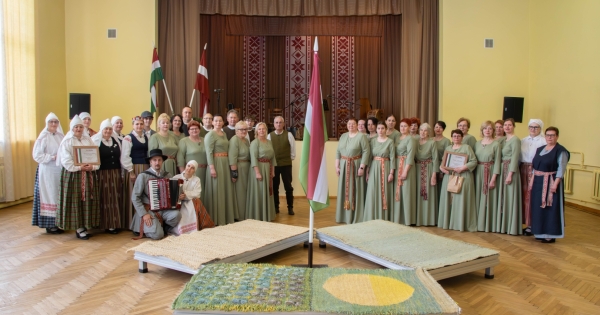
However, this stillness was contrasted by the raw energy of the performances. The folklore group “Ritam” from Bebrene brought a dynamic power to the stage, performing traditional rhythms that moved the audience beyond mere observation. The inclusion of the “Lašu koris” choir from Ilūkste and the traditional music group “Samaniai” from neighbouring Lithuania underscored the cross-border nature of this heritage. The Selonians historically inhabited lands on both sides of the modern Latvian-Lithuanian border, and the presence of Lithuanian performers served as a reminder that cultural identity rarely respects modern political lines.
The Universal Value of Regionalism
The celebrations in Eglaine offer a window into a broader European trend: the move away from centralised national narratives toward a more nuanced, regional appreciation of heritage. For the UK reader, this mirrors the revival of regional identities in places like Cornwall or Northumbria, where local dialects, flags, and folk traditions are being revitalised to provide a sense of belonging in a globalised world.
As Selonia continues to solidify its official symbols and document its intangible heritage, events like those in Eglaine are more than just local festivals. They are acts of cultural resilience. By combining the preservation of the past—such as the folk songbook—with contemporary creative expressions like Linarte-Ruža’s art, the region is ensuring that the “fifth star” of Latvia shines with its own distinct light, grounded in the soil and the songs of its people.
Source: Augšdaugavas novada pašvaldība